








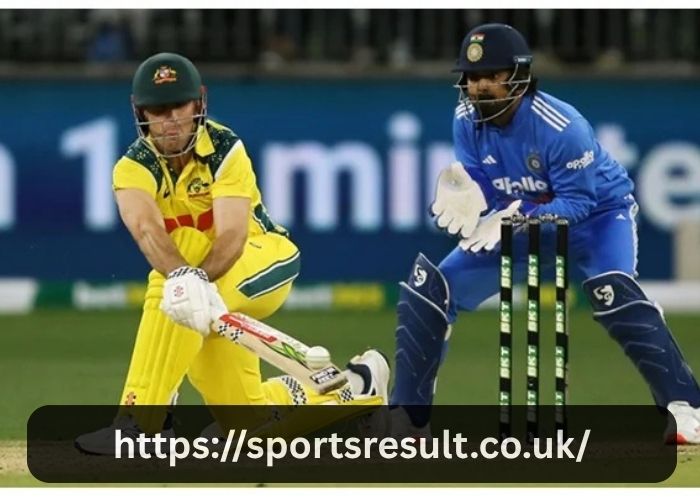
| No. | Date | Format | Venue | Australia Score | India Score | Result |
|---|---|---|---|---|---|---|
| 1 | 8 Nov 2025 | 5th T20I | Brisbane | Did not bat | 52/0 (4.5 ov) | No Result |
| 2 | 6 Nov 2025 | 4th T20I | Carrara | 119 (18.2 ov) | 167/8 (20 ov) | India won by 48 runs |
| 3 | 2 Nov 2025 | 3rd T20I | Hobart | 186/6 (20 ov) | 188/5 (18.3 ov) | India won by 5 wickets |
| 4 | 31 Oct 2025 | 2nd T20I | Melbourne | 126/6 (13.2 ov) | 125 (18.4 ov) | Australia won by 4 wickets |
| 5 | 29 Oct 2025 | 1st T20I | Canberra | Did not bat | 97/1 (9.4 ov) | No Result |
| 6 | 25 Oct 2025 | 3rd ODI | Sydney | 236 (46.4 ov) | 237/1 (38.3 ov) | India won by 9 wickets |
| 7 | 23 Oct 2025 | 2nd ODI | Adelaide | 265/8 (46.2 ov) | 264/9 (50 ov) | Australia won by 2 wickets |
| 8 | 19 Oct 2025 | 1st ODI | Perth | 131/3 (21.1 ov) | 136/9 (26 ov) | Australia won by 7 wickets (DLS) |
| 9 | 4 Mar 2025 | Champions Trophy Semi-final | Dubai | 264 (49.3 ov) | 267/6 (48.1 ov) | India won by 4 wickets |
| 10 | 3–5 Jan 2025 | 5th Test | Sydney | 181 & 162/4 | 185 & 157 | Australia won by 6 wickets |
Australian men?s cricket team vs india national cricket team timeline has seen some of the greatest drama and high-quality cricket on display over time, be it Border-Gavaskar Trophy drama or an ICC World Cup clash. A rivalry that has witnessed multiple historic finishes and series victories is always exciting to follow!
Australian Men’s Cricket Team Vs India National Cricket Team Timeline showcases a rivalry filled with history, competitive spirit, and modern cricketing excellence. This article highlights some of the most memorable matches and defining moments from their long-standing cricket journey.
The Early Years
At first, Australia held an advantage in test matches between these countries. But over time, as Indian players gained experience on foreign tours and formed more durable batting lineups, match results became closer.
This match ended in a tie despite both teams’ best efforts, thanks to Greg Matthews capturing India’s Maninder Singh with the last ball, leaving India needing 4 runs to win and leading to Vinoo Mankad running out Bill Brown for backing up too far.
The famous “Mankad incident” took place moments later as Vinoo Mankad ran him out due to backing up too far – an incident now famously known by cricket historians.
India went on to win the final test match of the series at Delhi after Rahul Dravid and Sachin Tendulkar both scored centuries – this marked India’s growing strength in test cricket while sparking a rivalry which would become dominant worldwide cricket, featuring iconic bowlers such as Warne, McGrath, Cummins from Australia; Kapil Dev, Javagal Srinath, Harbhajan Singh from India as part of it all.
The 1950s
The 1950s and 60s were turbulent years for Australian cricket, as audiences for domestic games dropped as other sports gained more favor, money was tight, and standards dropped significantly.
New South Wales led the state teams, playing exciting cricket that made an impression beyond Sheffield Shield boundaries under Keith Miller’s helm.
Miller was an unflappable captain, often taking daring gambles in the field while managing to avoid difficulty. His leadership style proved an ideal complement for his side’s aggressive batting strategy.
NSW was also dominant in Test cricket, as evidenced by their historic West Indies tour in 1956/57 – one of the greatest Test series ever played! NSW’s attacking style had an effect that spread throughout Australia – a period which would forever change cricket as we know it today.
The 1960s
Australia began building their international cricketing reputation during the 1960s due to their formidable batting and bowling. Legends such as Richie Benaud, Neil Harvey and Alan Davidson rose during this era – along with the V&G Knockout Cup as its inaugural domestic one-day tournament.
Australia took on England in 1968 for five-match Test series for The Ashes and ultimately prevailed 2-1 to keep possession. Furthermore, 20 first-class matches were played outside the tests series; seven victories, two losses, and eleven draws were registered during that tour.
India and Australia have faced off 14 times in ICC ODI World Cup matches, each side winning four matches each. Australia claimed victory by 125 runs in 2003 as they met for an epic World Cup final encounter. Both nations also met during Champions Trophy competition and World Test Championship events; India claimed both competitions twice while Australia triumphed three times!
The 1970s
In the 1970s, Warne, Lillee, Greg Chappell, and Rod Marsh rose to prominence. Their team defeated India 3-1 over five gruelling tests, during an era marked by riots, diet issues, umpiring problems and World Series Cricket being introduced.
WSC was the brainchild of Australian sports mogul Kerry Packer and featured white clothing and red balls instead of the more conventional 50 overs per match format. Furthermore, its launch prompted debate regarding media’s role and cricket itself as played.
In 1975, Australia and West Indies faced off for what many expected would be an epic Test series match-up, though many underestimated West Indian resilience.
Australia prevailed eventually despite Clive Lloyd’s century but not before making history by winning both matches in an era when batsmen only used one glove and had minimal protection. This memorable series remains iconic to this day.
The 1980s
Cricket experienced an extraordinary decade during this era. Two outstanding all-rounders, Ian Botham and Kapil Dev at their peak performances, along with Sunil Gavaskar from another continent all made notable contributions to cricket history.
West Indies team led by Vivian Richards and Malcolm Marshall were also an unstoppable force, dominating world cricket from start to finish of this decade.
Australians traveled to India expecting disaster, with most people expecting them to lose in an unlikely series that had only just started.
Border’s team, comprised primarily of inexperienced cricketers from his home state of Western Australia, only played a few Test matches together and five members unfamiliar with Indian conditions.
But to their credit, these tourists produced an extraordinary victory: winning the toss at Madras, quickly progressed on dry wickets with little bounce or turn early on before turning to Maninder Singh and Shivlal Yadav who together took seven wickets between them!
The 1990s
Australia and India’s cricket rivalry is among the best known in international cricket, playing a significant part in both countries’ growth; being one of only several rivalries that have both teams win major tournaments run by the International Cricket Council (ICC), at senior level both nations have won 10 ICC trophies; Australia six while India seven.
The 2022-23 Border-Gavaskar Trophy series marked a key moment between Australia and India since 1992-93; not only was this five-match Test series played between these countries for the inaugural time since then, it also marked Steve Waugh’s inaugural five-match captaincy of his country and final Test series before retiring from playing cricket altogether in November 2019.
After an inauspicious start to their innings on Day 3, India recovered with an outstanding partnership between VVS Laxman and Rahul Dravid on Day 3. Laxman scored unbeaten on 276 to set an Indian record for highest individual score at MCG Test match.
The 2000s
Australia enjoyed an extraordinary period of dominance in both Test and ODI cricket during the 2000s under Steve Waugh and Ponting, winning multiple Ashes series while decimating teams everywhere they faced off against.
Australia were unbeaten for 16 Test matches consecutively before India won three Test matches at Kolkata in March 2001 to claim victory and claim one of the greatest Test matches ever played, led by Laxman and Dravid’s epic 376-run partnership, to defeat Australia after they had been asked to follow on after being asked by their captain, Steve Waugh.
Harbhajan Singh became the first Indian cricketer ever to claim a Test hat-trick, dismissing Adam Gilchrist, Ricky Ponting and Shane Warne in consecutive balls in the final session of the second Test match in Pune. Additionally he picked off Sachin Tendulkar to ensure an emphatic win; an all-round performance which cemented his place among India’s great batsmen.
The 2010s
By 2010, Australian cricket was at its lowest ebb; every signal that came through seemed desperate and helpless.
AB de Villiers had made his mark as one of the greatest batsmen of his generation – an extraordinary batsman who could make seamers look meek or difficult wickets seem benign. Marcus North, Brad Haddin, Ricky Ponting and Michael Clarke had become increasingly weaker while Peter Siddle and Doug Bollinger were on their last legs.
But Australia’s constant reliance on five batsmen and an all-rounder was by far its greatest folly. This strategy failed in India in 2013 and 2017, England in 2014 and 2015 and UAE in 2016. As a result, players such as Moises Henriques and Glenn Maxwell were regularly picked; spinners such as Katich, North, Marnus Labuschagne or Nathan Lyon never got a fair opportunity. It was an unsuccessful formula.
The Present
Australian and Indian cricket rivalries are among the greatest rivalries in all sports, producing many great players and moments over decades of competition. Australia and India have met 304 times with Australia winning 146 matches to India’s 114.
Both sides also competed in other tournaments such as World Cup, Champions Trophy and Test Championship where Australia have taken home 10 ICC trophies; two World Cups and four Champions Trophies respectively while India have taken seven.
India produced an extraordinary comeback from 315-9 to win and retain the Border-Gavaskar Trophy since Kolkata 2001 and Adelaide 2003, through brilliant batsmanship led by Virender Sehwag and Mohammad Kaif.
Pragyan Ojha was hit in the back of his head by Mitchell Johnson’s delivery but on-field umpire Billy Bowden rejected Pragyan Ojha’s appeal against it and allowed India to score one run and secure victory in Nagpur.